

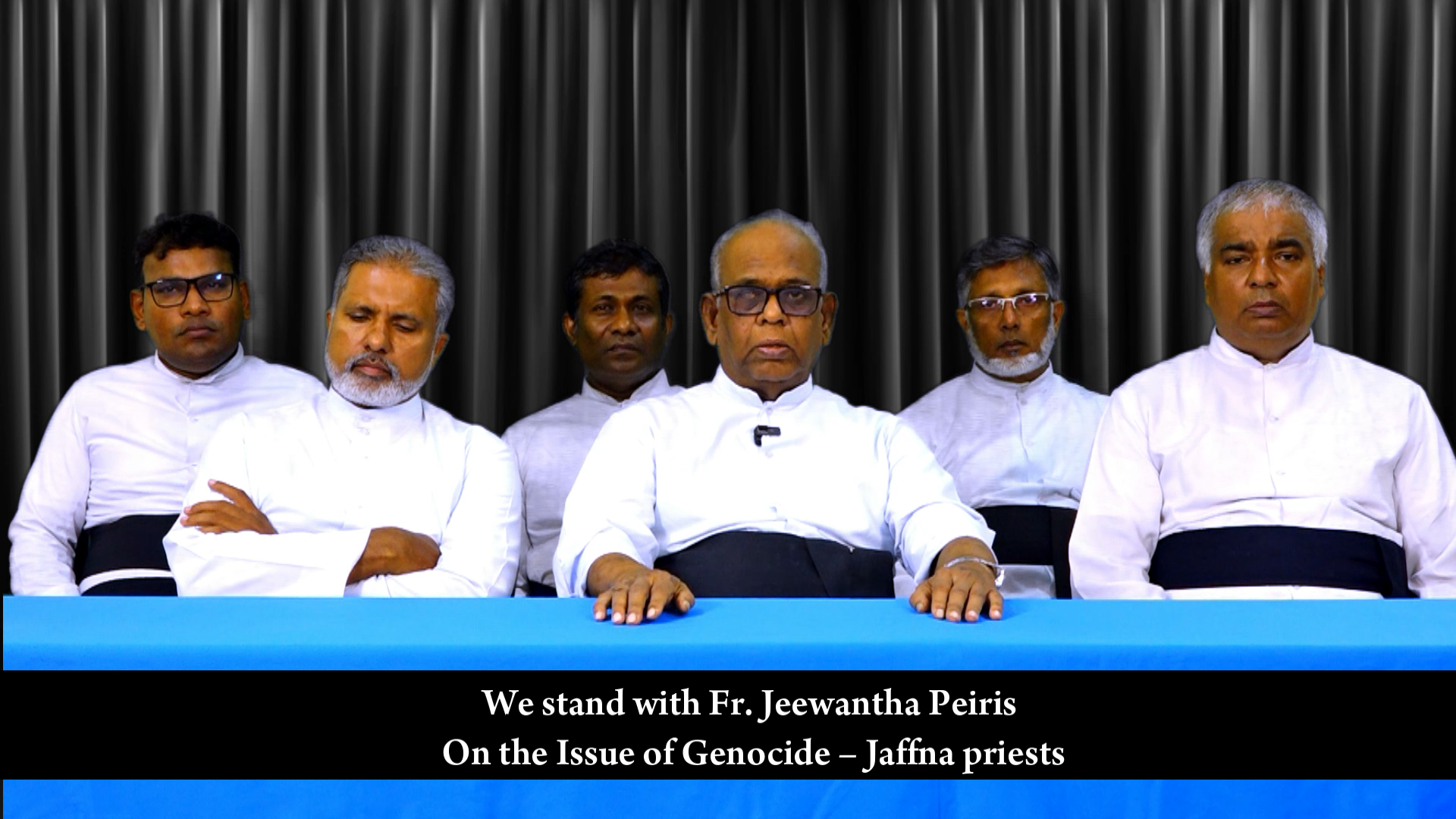
The priests of the Diocese of Jaffna have expressed deep concern and disappointment over a statement issued by Rev. Fr. Jude Chrishantha, Director of the Catholic National Commission for Mass Media and Social Communications of Sri Lanka, in response to remarks made by Rev. Fr. Jeevantha Peiris of the Diocese of Ratnapura regarding the Tamil genocide, the ethnic conflict, and the civil war.
At a press conference, the Jaffna diocesan priests voiced their support for Fr. Jeevantha Peiris and stated that the long-standing injustices, violence, and suffering experienced by the Tamil people form part of a systematic process of genocide, which they said reached its tragic climax in Mullivaikkal in 2009.
Rev. Fr. V. Vasanthan noted that the late Bishop of Mannar, Rt. Rev. Dr. Rayappu Joseph, had submitted evidence to the United Nations Human Rights Council indicating that over 146,000 Tamil civilians were killed or disappeared during the final stages of the war. He further stated that Fr. Jeevantha’s remarks should not be seen as a personal opinion, but as reflections based on visits to affected areas and testimonies from local communities and clergy.
Rev. Fr. Mangalaraja strongly defended the characterization of the suffering of Tamils during the conflict as systematic genocide, expressing disappointment over responses from certain sections of the Church. He said that communities in the North and East, who lived through decades of war, widely interpret these events as genocide, and added that such claims are often treated differently depending on who raises them.
He referred to the 1981 burning of the Jaffna Public Library as an act of cultural destruction, and cited the ongoing Chemmani mass grave excavations, along with other grave sites in Mannar, Thiruketheeswaram, and Kokkilai, as evidence of large-scale human rights violations. He also recalled civilian deaths during the final phase of the war, including in designated No Fire Zones, alleging shelling, starvation, and lack of medical care.
The statement also highlighted enforced disappearances, unresolved cases of persons who surrendered or were taken for questioning, and questioned the effectiveness of official investigations into missing persons. Past incidents involving attacks on civilians, clergy, journalists, and places of worship were also cited.
The priests further noted international scrutiny of alleged war crimes, including sanctions imposed by some foreign governments on Sri Lankan military figures, as evidence of continued global attention to wartime accountability.
They concluded by commending Fr. Jeevantha Peiris for his courage in speaking about the suffering of the Tamil people, and reiterated that lasting peace and reconciliation in Sri Lanka can only be achieved through truth, justice, accountability, and recognition of victims’ experiences.