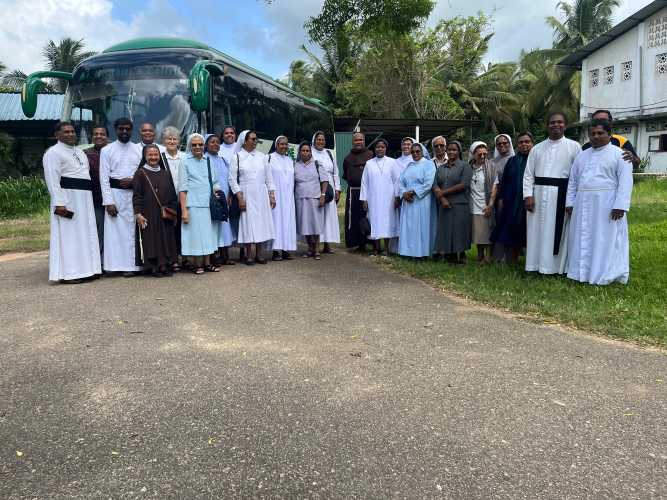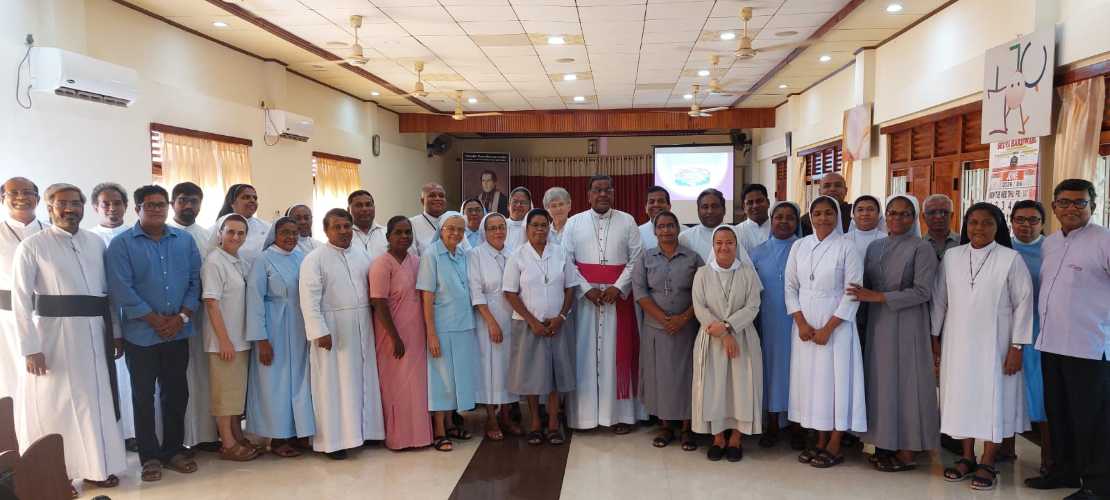
The Conference of Major Religious Superiors serving in Sri Lanka was held from June 21 to 24, bringing together religious leaders from across the country for a four-day programme of prayer, reflection, discussions, and visits to significant religious and historical sites.
The gathering was chaired by the President of the Conference of Major Religious Superiors, Rev. Fr. Justin Chawhan, of the Congregation of the Blessed Sacrament. The programme commenced on June 21, with participants travelling from Colombo to the Shrine of Our Lady of Madhu, where they took part in the Holy Eucharist and a special prayer service. They also visited the Mannar Martyrs’ De La Salle House and the Alcoholics Anonymous Rehabilitation Centre at Thoddavely, reflecting on pastoral care and social healing ministries.
On June 22, the main sessions were held at the Holy Family Provincial House in Jaffna. The day included the presentation of reports, group discussions, and a keynote address. A significant academic input was delivered by former Vice-Chancellor of the University of Jaffna, Prof. Sri Satkunarajah, who presented on “Beyond Boundaries: The Human Quest for Fulfilment.” Participants were also welcomed by the Bishop of Jaffna, Rt. Rev. Dr. Justin Gnanapragasam, who met with the delegates during the gathering.
On June 23, the delegates undertook a study and exposure visit to several cultural, religious, and historical landmarks in Jaffna. These included the Nallur Kandaswamy Temple, Nilavarai Well, Sangamiththa Viharaya, the Theological Seminary at Maruthanarmadam, the Jaffna Public Library, Jaffna Fort, St. Francis Xavier Major Seminary, and St. Mary’s Cathedral. The visits provided participants with an opportunity to reflect on the region’s rich spiritual heritage and historical experiences.
The final day, June 24, featured concluding discussions followed by field visits. Participants visited the Holy Family Convent National School Jaffna, recognized as the first school established by the Holy Family Sisters in Sri Lanka, as well as the Chemmani mass grave excavation site, a location of deep historical and humanitarian significance.
Around 40 priests, religious sisters, brothers, and pastoral workers participated in the four-day national gathering, which emphasized dialogue, pastoral collaboration, and engagement with both spiritual and social realities in the country.