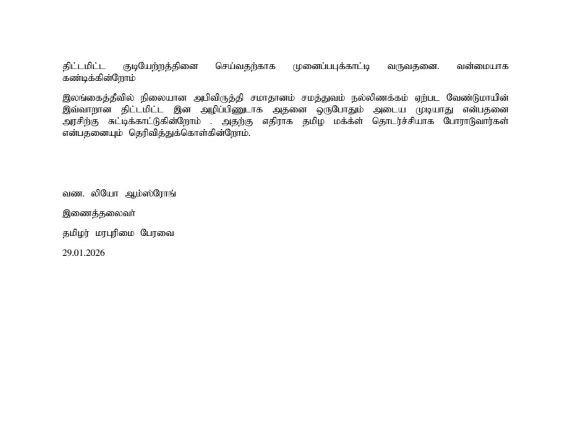
The Tamil Heritage Preservation Council has warned that lasting reconciliation in Sri Lanka cannot be achieved through planned acts of ethnic dispossession, citing concerns over the Kivil Oya irrigation project.
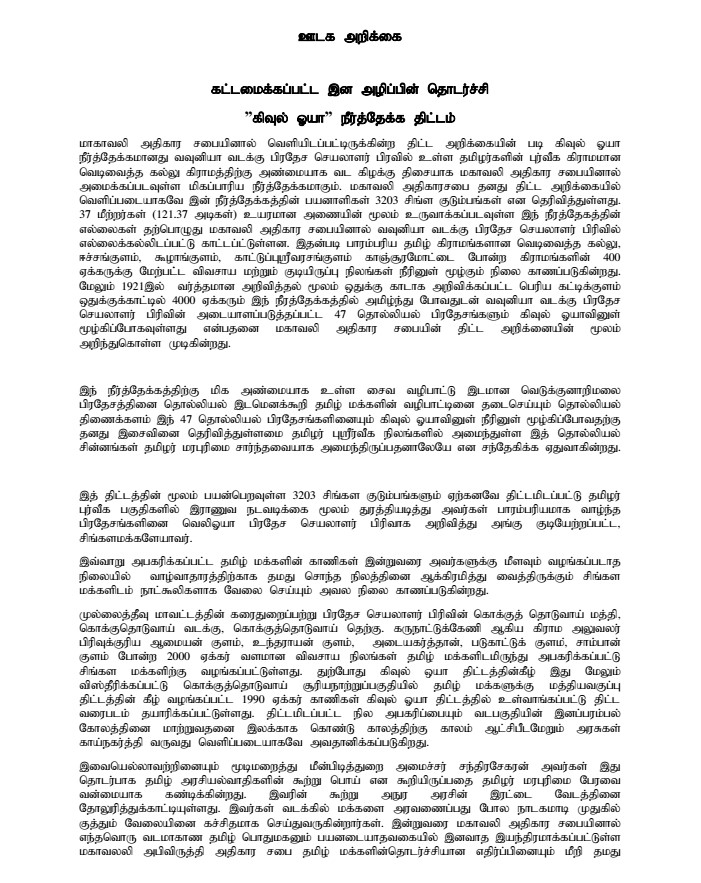
In a statement released on January 29, the Council highlighted that more than 400 acres of agricultural and residential land in Tamil ancestral villages under the Vavuniya North Regional Secretary Division – including Vedivaithakal, Eechankulam, Koolankulam, Kattuppuvarasankulam, and Kanchuramottai – as well as 4,000 acres in the Periya Kattukulam reservoir reserve, and 47 identified archaeological sites, are all at risk of being submerged by the project.
The statement also pointed out that the Department of Archaeology, which has classified the Veddakunari Malai area near the reservoir as an archaeological site and restricted Tamil religious practices there, has expressed consent for these 47 sites to be submerged, raising concerns that this may be a deliberate attempt to encroach upon Tamil ancestral lands.
The Council drew attention to the continued plight of the Tamil population, whose lands confiscated by the military have not yet been returned. Many Tamils are now forced to work as laborers on lands occupied by Sinhalese settlers, threatening their livelihoods.
The statement also recalled that 2,000 acres of fertile agricultural land in the Mullaitivu district had previously been seized from Tamils and handed over to Sinhalese settlers. It warned that the Kivil Oya project will further expand such land grabs, accusing successive governments of using these schemes to alter the ethnic composition of the North.
The Council emphasized that the government’s persistence in implementing resettlement plans, despite opposition from the Tamil population and without benefiting them, undermines reconciliation and raises serious concerns about the future of inter-ethnic harmony in the region.